What turnover measures — and what it does not
Turnover is the hospitality trade's measure of how hard a room works. Every table you own can only be sat so many times between opening and closing; turnover is the count of how many times they actually were.
It is a capacity number, not a service-quality number. Two cafés with identical turnover can be running completely different businesses: one turning tables quickly because the coffee is drunk standing at the counter, one turning them slowly because the brunch is long and the bill is high. Both can be healthy.
The word is also easily confused with staff turnover, which is about employees leaving. Same word, unrelated metric; the two only ever meet in the same spreadsheet.
The formula, worked through
The standard calculation counts parties — groups — not individual guests, and always over a window you name in advance, because a rate without a window is not a number:
TABLE TURNOVER RATE
parties served ÷ tables available
Worked example. One Saturday, a café seats 96 parties. The room has 24 tables.
96 ÷ 24 = 4.0 turns per table that Saturday.
The same room over the three-hour lunch window alone — say 36 parties — turns 1.5 times.
Either answer is correct. They answer different questions, which is why the window is part of the definition.
The example figures are illustrative, not a benchmark for any kind of venue.
The seat-based variant
Counting tables treats a two-top and a six-top as equal, which they are not. The finer variant counts seats instead, and suits rooms with mixed table sizes:
SEAT USAGE
covers served ÷ seats available
The same Saturday serves 210 covers against 60 seats: 210 ÷ 60 = 3.5.
Use the table version when you compare the same room against itself; use the seat version when the mix of table sizes keeps changing.
Again an illustration, chosen to make the arithmetic easy to check.
What counts as a good rate
There is no honest universal number. A station-coffee bar where nobody sits down, a quick lunch room, a slow afternoon café and a dinner restaurant have different dwell times built into what they sell — the product sets the pace, and a benchmark borrowed from a different concept measures nothing about yours.
The useful comparisons are the same room week against week, the same weekday against its twin, and this April against last April. Those comparisons hold the concept constant, which is the only way the number means anything.
Treat the rate as a diagnostic rather than a target to push at any cost. A rate that rises because guests feel hurried tends to show up somewhere else — smaller average bills, shorter return visits, quieter word of mouth.
Where the time at a table actually goes
A table's life is mostly waiting. The order waits to be taken, the kitchen waits to be told, the food waits to be carried out, the guest waits to order the next round, and at the end everyone waits for the bill to arrive, be split and be settled.
None of that time belongs to the guest's enjoyment of the meal, and guests do not miss it when it shrinks. An order that reaches the kitchen the moment it is taken, and a bill that arrives when it is asked for, shorten the visit without touching a single minute of the sitting.
That is the distinction worth holding onto. Removing lag is a service to the guest; hurrying them is not. The first raises turnover and satisfaction together — the second trades one for the other.
Raising turnover without rushing anyone
The reliable levers are matters of process, not of furniture:
- Take the order at the table instead of walking it to a terminal — the walk is the lag.
- Send each round to the kitchen as it is ordered, rather than batching two tables into one trip.
- Let the table ask for the bill from where it sits; a raised hand is a slow protocol.
- Split the bill where it is asked to be split — by item or by amount — without arithmetic at the table.
- Clear and reset the moment a party leaves; an unbussed table is occupied but not earning.
- Move the party to the right table when the group grows, instead of pushing tables around mid-service.
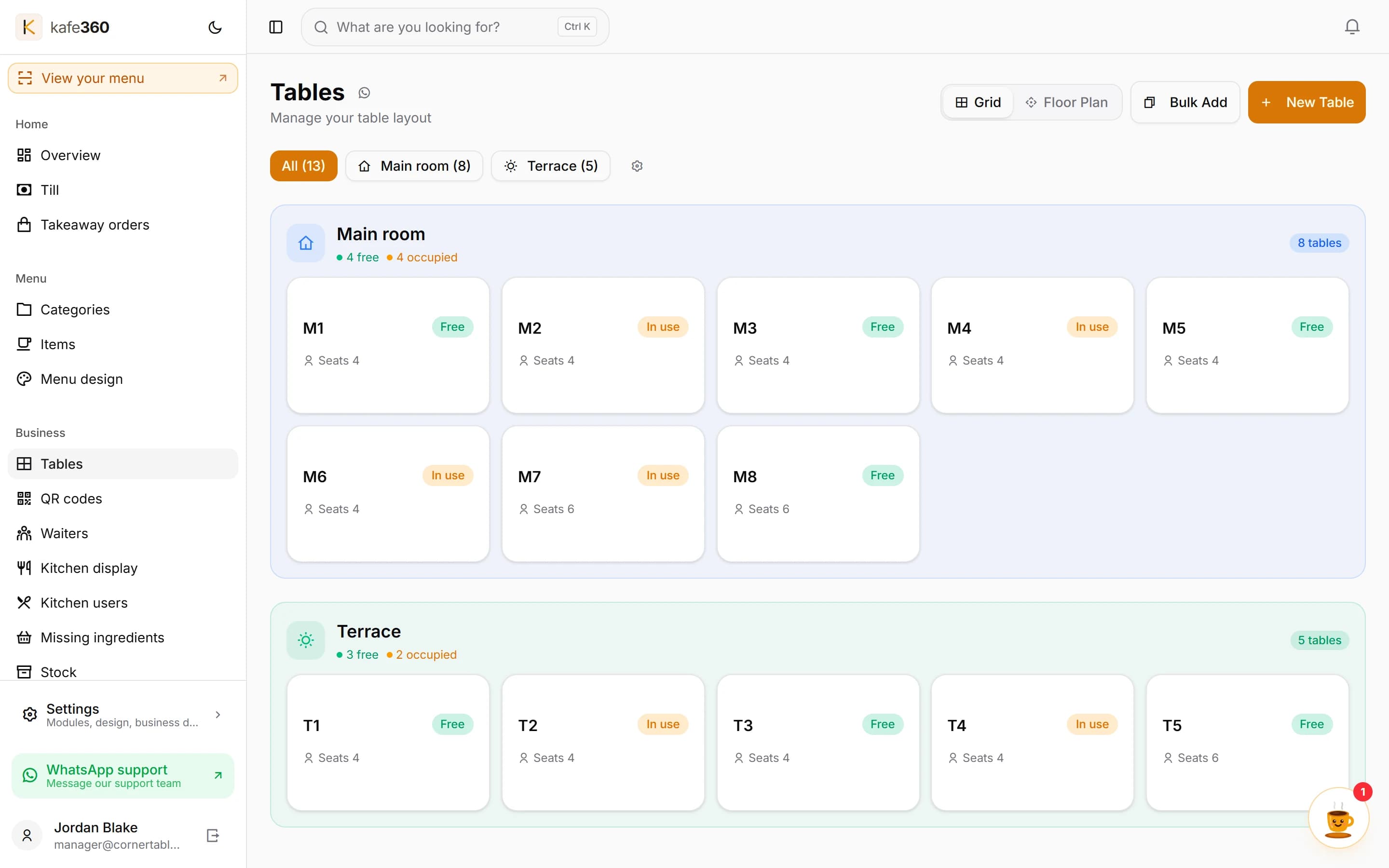
None of this hurries anyone — it removes the lag between the steps, which is why Kafe360 is built around exactly this list: the waiter orders at the table in a phone browser, the kitchen sees the order the moment it is sent, the bill splits by item while tables move and merge from the same screen, and the panel reports the average sitting time per table so the change shows up in numbers rather than in a feeling.
Measuring it honestly
The common mistakes are all definitional, and every one of them quietly changes the number:
- Counting covers as parties — four friends on one bill are one turn of that table.
- Changing the window between measurements. "This week" and "Saturdays" answer different questions; pick one and keep it.
- Inconsistent treatment of reserved, empty and closed-off tables across the periods being compared.
- Reading a daily average that hides the peak — the lunch hour is where the money is, and the mean averages it away.
- Comparing against a concept that is not yours.
- Mixing instruments — the party count should come from the same place each time, whether that is the till's closed bills or a manual tally.