What split billing actually means
Split billing is the practice of settling one table's bill in more than one payment. The bill itself does not change — the items, the total and the table stay as they are — only the paying is divided. A table of six might produce six payments, three payments, or one payment and a pile of bank transfers argued about on the pavement.
It is worth separating from two neighbours it gets confused with. Split billing is not itemised receipts for a single payer — every till can print those. And it is not a discount; nothing comes off the total. It is a payment pattern, and it makes demands of a till that a single-payment till never faces.
The demand, in one sentence, is that the bill must survive being paid in pieces. Totals must know what is still due after every payment; lines that have been paid must stop being payable; and the table must free itself at the right moment — not when the first payment lands, and not never.
The three ways to split a bill
Nearly every split at a real table is one of three shapes. They have different speeds, and different ways of going wrong.
| By item | Equally | By amount | |
|---|---|---|---|
| What happens | Each guest's items are ticked and paid as one payment | The total is divided into equal shares, whatever anyone ordered | Fixed amounts are taken off the total, one by one |
| Best when | Orders were separate and the list is long | Everybody shared roughly the same, or nobody wants arithmetic | One guest pays part now and part later, or cash and card are mixed |
| Where it goes wrong | Shared plates and rounds have no single owner | The guest who only had a salad subsidises the wine | The last payer inherits the rounding and the unclaimed items |
| What the till needs | Item-level selection, and paid lines that lock | A division and a running remainder — or a calculator and patience | An open remainder that survives part payments |
Mixing the ways is normal — two guests pay by item, the rest split what is left. A till that handles items and amounts handles every mix; a till that only handles equal shares handles the one shape that causes the arguments.
Mistakes at bill time
Bill time is the most expensive minute in the room. The kitchen is closed or closing, the staff are tired, and every error here happens in front of the guest and often in front of their money. The recurring mistakes are few, and all of them are older than till systems:
- Paying a line twice — two people both ticked the same cheesecake, or the till let a paid line be selected again. Paid lines must lock, visibly.
- The void that never happened — the guest says the wrong dish never arrived; the bill says otherwise. Without a recorded cancellation with a reason and a name, the argument is unwinnable in both directions.
- Arithmetic drift on equal splits — dividing a total that still contains service, or dividing the food but forgetting the drinks bought at the bar. The parts are right and the whole is wrong.
- The unclaimed item — somebody's second coffee never found a payer, and the last guest absorbed it without noticing.
- Closing too early — the bill closes when the payments cover the total, not at the first payment, and not when a payer says that is probably everything.
None of these are exotic. They are the ordinary friction of dividing a number between people who remember the evening differently — and they are the reason the split is a till feature rather than a calculator feature. A till can lock what has been paid, keep the remainder visible and put a name on every change; a calculator can only divide.
What a till needs to split well
Whatever the brand on the box, a till that splits bills safely does four things. It selects at the item level, not just the whole bill. It takes amounts against a running remainder. It locks lines and payments once taken, so nothing is paid twice and nothing can be quietly cancelled afterwards. And it keeps the history of the bill — every payment, in order, with who took it — so that when a guest comes back about their card statement, the answer is on the screen.
The weakest version of split billing in the wild is the printed-bill-and-scissors shuffle: the itemised receipt is cut in half and each half is charged as a new total on the card terminal. It works, in the sense that the money arrives. It fails the moment a payment is questioned, because no record ties the scissors to the card.
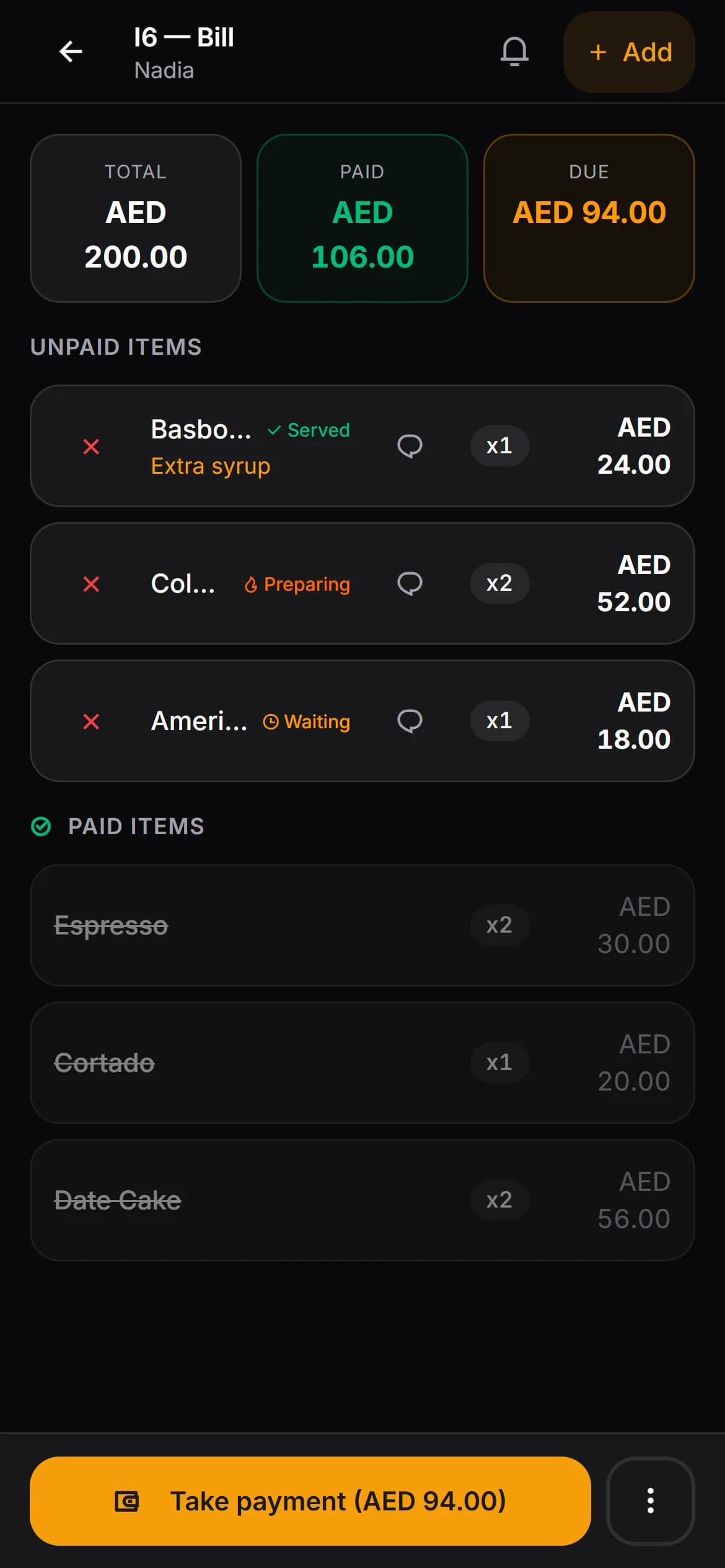
Kafe360 splits bills the thorough way — lines are ticked and paid one payer at a time, amounts come off a visible remainder, part payments leave the bill open, and paid lines lock against both a second payment and an after-the-fact cancellation.
Equal shares are the one shape left to the room itself. With item-level and amount-level splitting both working, dividing the total by the table is a moment's arithmetic in between — and the remainder on the screen keeps the last payer honest.