A till system for dessert shops
Dessert trade is wide rather than deep — a handful of bases, a long list of ways to finish them. This page says how a till carries that width, and which parts of a dessert room it cannot help with.
Last updated
What a dessert shop actually needs from a till
A dessert menu is a matrix, and the awkward bill is its house special. The till has to hold the width without slowing the counter down.
Choices, not menu items
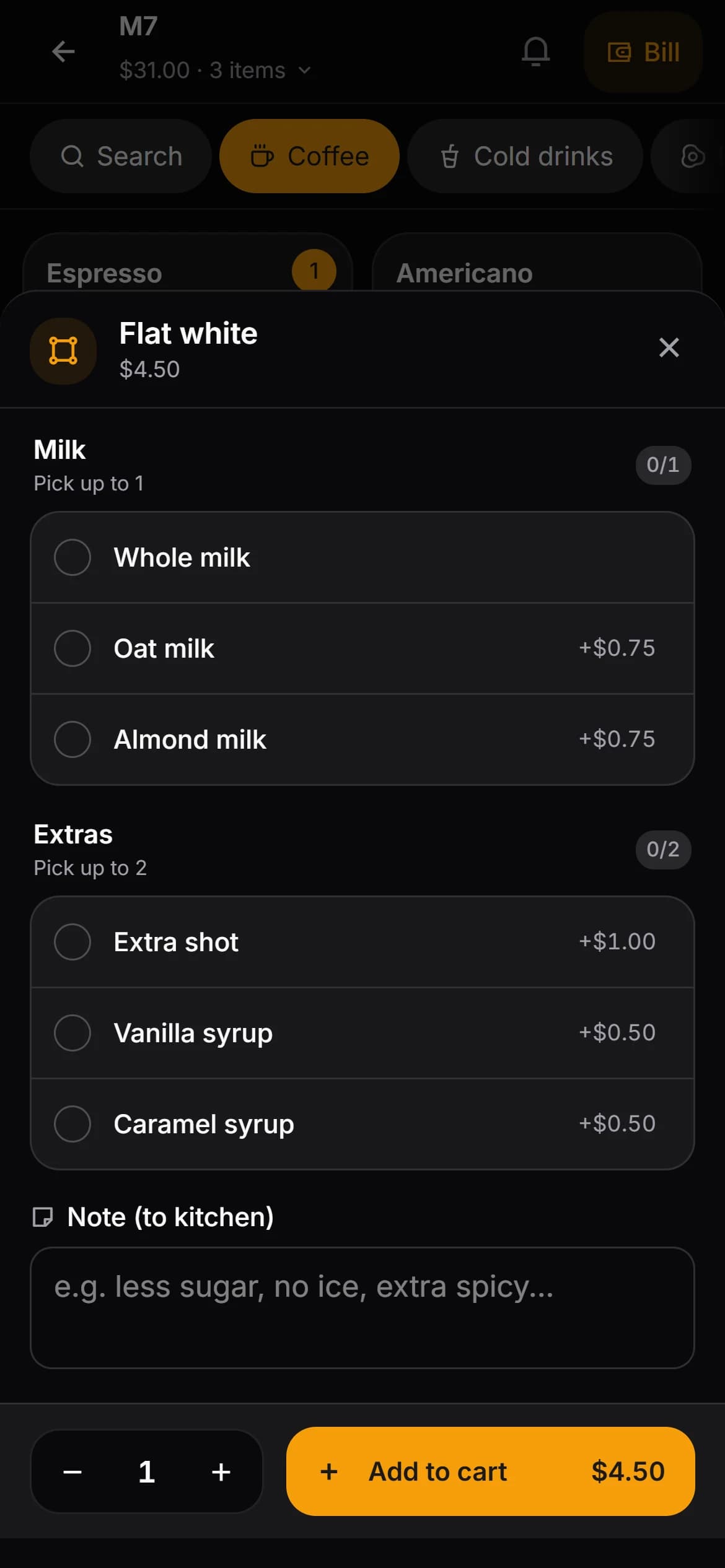
The menu is one waffle with twenty endings, not twenty waffles. Size, sauce, toppings and the extra scoop should be chosen at the till, priced by the system, and impossible to get wrong at the counter.
A display case that keeps selling when you cannot
Guests take longer to choose here than anywhere else in hospitality. Photos they can browse at the table or in the queue do the explaining while the counter gets on with the melting part of the trade.
Allergens, asked once
Nuts, gluten, dairy and egg are the daily questions of a dessert room. The answer should be on the item, in the guest's own hands if possible — not shouted across a busy counter and hoped at.
The birthday table
Eight friends, one bill, four payments and somebody's card behind the till. The awkward bill is where dessert shops lose their evening smile; the till should eat it without a calculator.
Where Kafe360 fits
The parts that carry a menu of choices, each with the page that goes deeper.
Option groups with their own prices
Each item carries its groups — size, sauce, extras — with a minimum and maximum choice, their own prices and a quantity where that makes sense. The price difference applies as the choice is made; nobody adds the extra scoop from memory.
See the featurePhotos that do the selling
A photo on every item, loaded once and resized for the phone automatically, readable from the table's own QR code or from a plain link. The guest enlarges the plate; the counter keeps moving.
See the featureAllergen filters, guest-side
Tag what each item contains, and the guest filters the menu on their own phone by what they cannot have — calories can sit on the item too. The filter is only as good as the tagging; an honest menu says what it does not know.
See the featureThe awkward bill, handled
Tick the items each payer is owning, or take amounts off the total one by one. Paid lines lock, the rest stays open, and the table frees itself when the last payment lands.
See the featureSauces and scoops, counted as they go
Ingredients defined once, recipes saying what each dessert uses, every sale deducting the amounts. Quantities only — no cost per gram and no margin per dish; the counting is the useful half.
See the featureREAD THIS PART TWICE
Where it does not
The gaps a dessert counter is most likely to hit. None of them is hidden in small print somewhere else.
Nothing is priced by weight.
Every item and every option carries a fixed price. There is no scale, no per-hundred-grams pricing and no variable-weight line. A counter that sells loose sweets by the scoop-and-scale needs a different tool for that part of the trade.
The menu does not take the guest's money.
Ordering from the table sends an order, not a payment. The bill is settled at the counter or with the waiter, the way you already take money — cards go through your own reader and are recorded, not taken.
No loyalty points.
There is no stamp card, no points balance and no visit history attached to a guest. A tenth-dessert-free promise is a paper card or a separate tool; the system will not accidentally run it for you.
No delivery platform integration.
Delivery app orders stay on the platform's tablet and are typed in like a walk-in. Nothing is pulled in automatically, in any country this is sold in.
Questions dessert shop owners ask
Can one waffle really have sizes, sauces and extras?
Yes — as option groups on the item, each with its own price, a minimum and a maximum choice, and a sensible default so the common order stays fast. The price difference is applied by the till as the choices are made.
How do guests with allergies use it?
Tag each item with what it contains, and the guest filters the menu on their own phone by what they cannot have. The filter is exactly as good as the tagging — a menu that does not know an answer should say so rather than guess.
Eight friends, one bill, four ways to pay?
Split by item or by amount, at the table on a waiter's phone or at the till. Paid lines lock, the remainder stays open, and the table goes back to free when the last payment covers it.
Can it count the sauces and toppings?
As quantities, yes — define the ingredient, give each dessert a recipe, and sales deduct the amounts, with low levels marked in the panel. As money, no: no ingredient carries a price, so there is no margin per dish.
Do guests pay through the QR menu?
No. Ordering from the table sends an order — it waits for a human nod or goes to the kitchen, your choice — and money changes hands the way it already does, at the counter or with the waiter. The till records cash and card; it does not take either.
Keep reading
FEATURE
QR menu
Codes per table, photos, allergen filters, ten languages.
See the featureGLOSSARY TERM
Split billing
What split billing means — by item, into equal shares, or as amounts off the total — the mistakes that happen at bill time, and what a till must do to make splitting safe.
Read the definitionVENUE TYPE
A till system for bakeries
A till system for a bakery counter — the morning queue, selling out honestly, counting flour by the loaf — and the parts of the trade a till cannot carry.
See the pagePut Saturday night's menu through it.
Thirty days on your own menu and toppings — no card, no hardware to buy.