A till system for bakeries
A bakery's trade is decided before seven, sold out by eleven and counted after close. This page says plainly which parts of that day a till carries well, and which parts it does not carry at all.
Last updated
What a bakery actually needs from a till
A bakery decides its day before most kitchens have switched the light on, and the till has to survive that hour without becoming the bottleneck. Four needs cover most of it.
A counter that keeps up with the queue
The morning is a fixed appointment — the same faces, the same short window, before work. Every extra tap per sale is paid for down the whole queue, and a till that asks questions mid-rush is worse than the paper bag and pen.
Sell-out, handled in one touch
The croissants finish at half nine and the granola bars at eleven. What is gone should leave the board for the rest of the day, and come back tomorrow morning without being rebuilt.
The day's production, counted honestly
What was baked, what sold at which hour, what was left on the shelf at close. Counted as it happens, not reconstructed on Sunday from delivery notes and a rough memory.
Orders for now, not for Thursday
Counter trade is immediate — point, bag, pay. Where a bakery also sells on order, a cake for Saturday or a standing wholesale round, that is a different kind of promise than a till receipt.
Where Kafe360 fits
The parts of the system that pull their weight at a bakery counter, each with the page that describes it properly.
Fast entry, on whatever is on the counter
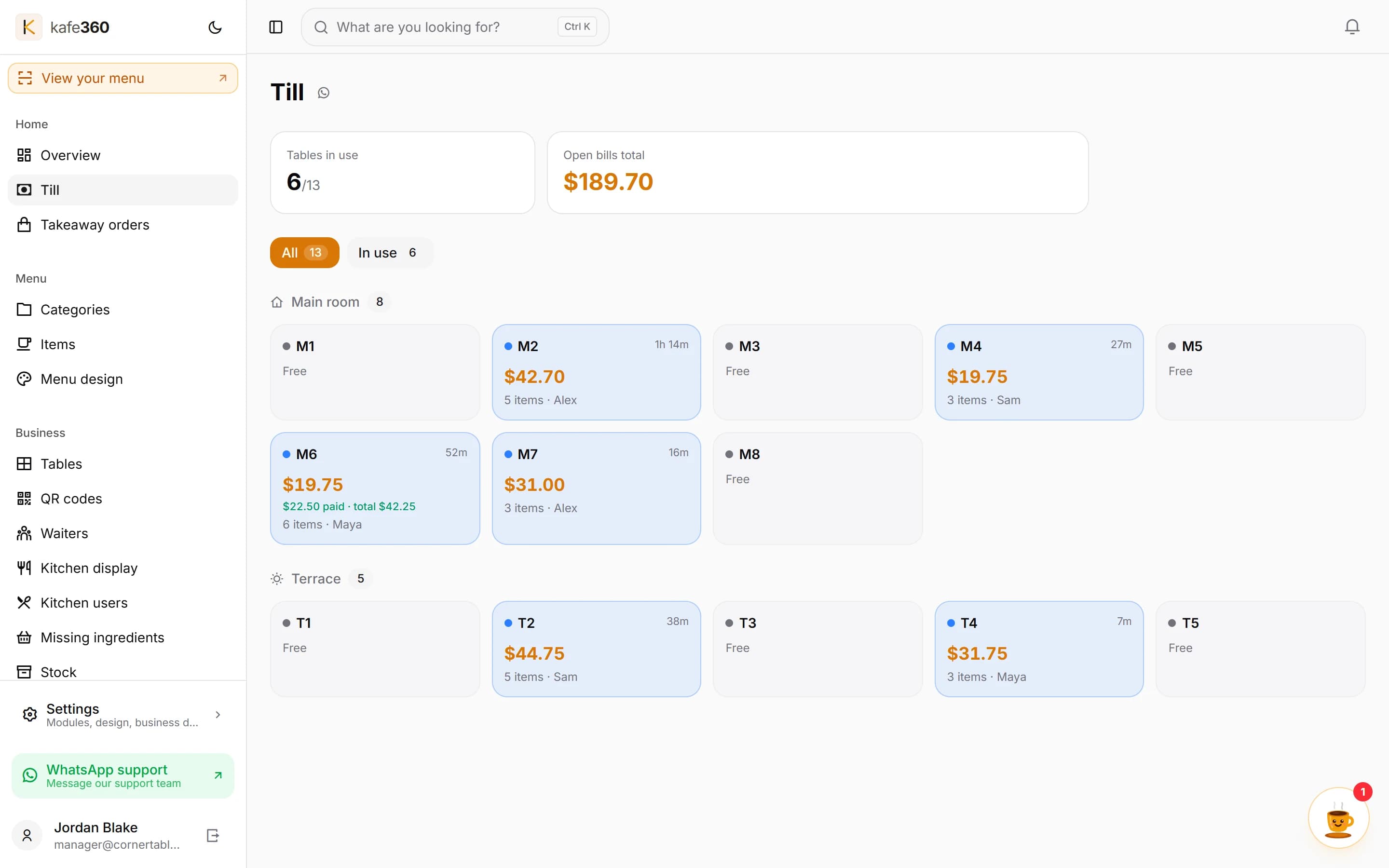
Items sit in categories with a search box above them, and photos can sit on the buttons for new Saturday staff. It runs in a browser, so the device is whatever the building already has.
See the featureSold out means off the board
Switch an item off and it leaves the menu — the counter list and the QR menu alike — until you switch it back tomorrow. Nothing is deleted; the photo, the price and the recipe wait where they were.
See the featureFlour and butter, deducted as loaves sell
Ingredients are defined once, recipes say what each product uses, and every sale takes those amounts off the counts. Quantities only — there is no cost per ingredient and no margin report; it counts what left, not what it cost.
See the featureThe morning, in numbers you can act on
Sales by the hour show when the queue actually pays for the second pair of hands; best sellers show what to bake more of, and the ones that barely move show what to stop baking.
See the featureA takeaway board for counter trade
Takeaway orders run on their own numbered board with their own statuses, off until you switch it on. A bakery with a couple of stools — or none — does not have to pretend its counter is a dining room.
See the featureREAD THIS PART TWICE
Where it does not
A bakery is the venue type this system fits least neatly on this list — better to read the gaps before the trial than in the second week of it.
No production planning.
The reports tell you what sold. They do not tell you what to bake tomorrow, hold a par level per item, or turn Saturday's curve into a mixing list. The baking plan stays wherever it lives today.
No pre-orders and no dated orders.
There is no order for collection on Thursday at eight. Orders are for now; a cake ordered a week ahead for a fixed date is a promise the system has no place to keep. Bakeries built on advance orders need a separate tool for that half of the trade.
It does not take card payments.
Your own reader does that, at the counter as anywhere else. The till records which sales were card and which were cash, and the end-of-day report splits the two — the money itself never passes through it.
No delivery platform integration.
If the bakery also lists on a delivery app, those orders stay on the platform's own tablet and are typed in like any walk-in. Nothing is pulled in automatically, in any country this is sold in.
Questions bakery owners ask
Can a bakery with no tables use this?
Yes, though it is worth being honest about the shape. The bill flow is built around tables; counter trade runs better as takeaway orders, which have their own numbered board, their own statuses and their own payments. Put one real morning through it in the trial before deciding.
How do I mark the sourdough sold out?
Edit the item and switch it off. It leaves the counter list and the QR menu for the rest of the day, and comes back when you switch it on again — the photo, the price and the recipe stay put.
Can it count flour and butter for me?
Partly, and it is worth knowing which part. Define ingredients, give each product a recipe, and sales deduct the amounts automatically. What it does not do is put a price on a gram — there is no cost per ingredient and no margin per loaf.
Does it handle orders for a fixed day, like Saturday cakes?
No. An order is taken for the moment it is sent; there is no collection date, no calendar and no reminder. That trade needs a notebook, a form or a separate booking tool alongside.
What hardware does a bakery need to start?
None from us. The panel and the till run in a browser on a phone, a tablet or the laptop already on the counter. Receipts are optional — a browser-printed USB thermal receipt after payment, or a network printer through a small bridge program on a Windows machine.
Keep reading
FEATURE
Stock control
Recipes that deduct themselves, low-stock warnings.
See the featureGUIDE
Moving from paper to a till system
How to move a café from paper orders to a till system — preparation, entering the menu, staff training, the first live day, a parallel week and a rollback rule written in advance.
Read the guideVENUE TYPE
A till system for dessert shops
A till system for a dessert shop — one waffle with twenty endings, priced correctly at the counter — and the parts of the trade it leaves alone.
See the pageBake Friday's list from Thursday's numbers.
Thirty days on your own bread and coffee — no card, no hardware to buy.