A till system for bars and pubs
A bar's evening runs backwards from the rush, and a till faces two exams there — the three minutes a waiter stands at a table, and the hour after the doors shut. This page is about both.
Last updated
What a bar or pub actually needs from a till
Neither exam is about features. One is about not making the floor wait; the other is about closing a night that ends at two in the morning without a second spreadsheet.
One bill that survives the night
The order opens with the first round and stays open for hours. Nothing should be re-keyed at midnight because a table moved to the terrace or two tables became one group of twelve.
Rounds, added where the guests are
A second round joins the bill it belongs to, and the bar hears it without the waiter walking the length of the room. The bill should remember which round the extra pint arrived in, because the guests will not.
A close that knows which night it was
Trade that ends at two in the morning is one night, not two calendar days. The takings, the voids and the end-of-day report should all agree on that.
Staff you can trust with a fast counter
Who may void a line, who may take a payment, who may touch a price — decided in advance and written down afterwards, not argued about from memory on Sunday.
Where Kafe360 fits
The parts that do bar-shaped work, each with the page that goes deeper.
The bill that stays open
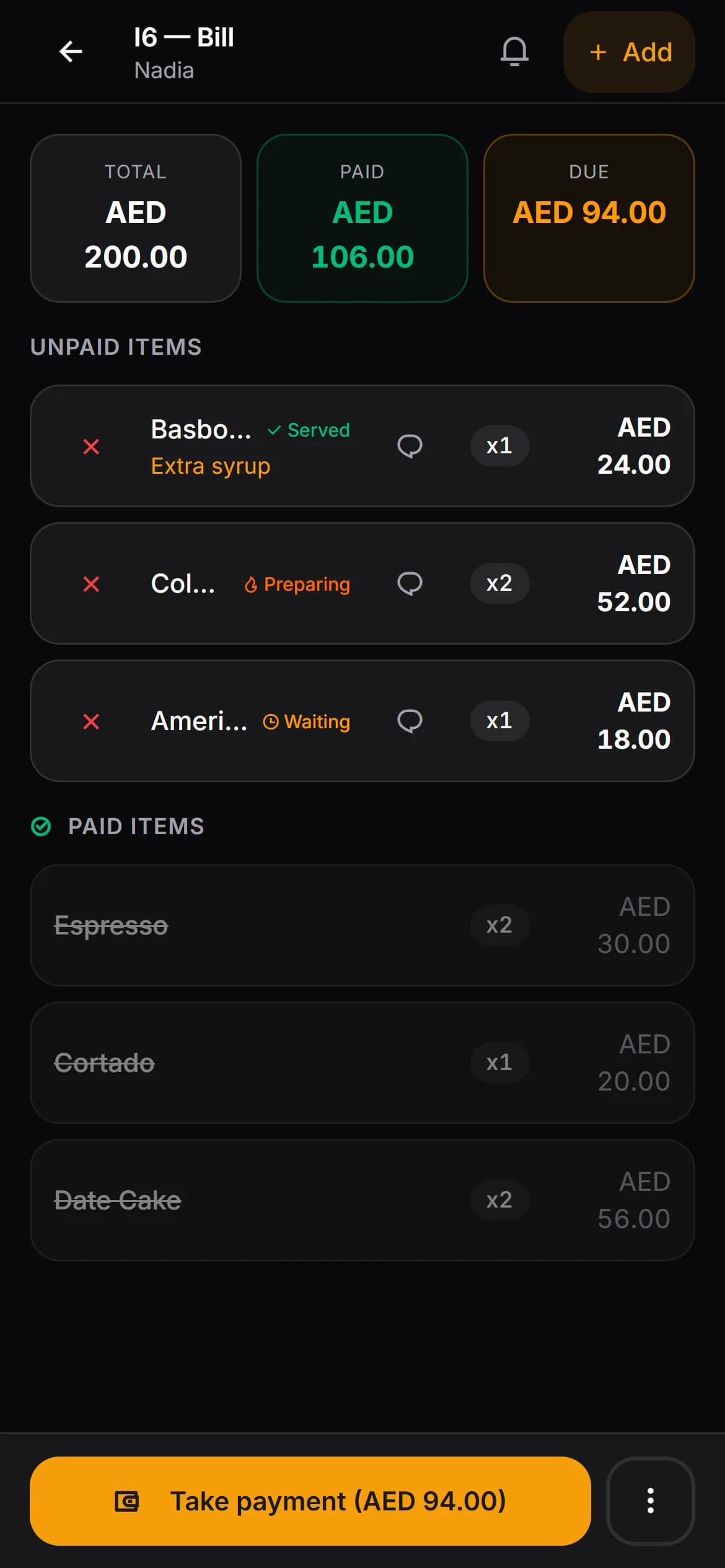
Every table carries one open bill. Paid and unpaid lines stay apart, part payments leave the rest open, and when the payments cover the total the bill closes itself and the table goes back to free.
See the featureRounds land on the right bill
A round is added to the order that is already open, and the bill groups what is unpaid by round, each with its time on it. Another round at eleven is a fact on the screen, not a debate at the door.
See the featureYour business day, your hours
Set the day to roll over at five or six in the morning, and the half-one sale belongs to the night it was part of — on the dashboard, in the reports and on that night's end-of-day snapshot.
See the featureNames on every void
Voids ask for a reason and keep the name, the time and the item. Taking payment is a permission you can withhold per waiter, and changing a price is not something floor staff can do at all.
See the featureA tab for the regular
Customer accounts, once switched on, let a bill be charged to a named regular instead of paid — the balance goes up, and comes down when they settle. It is the paper bar tab, with the arithmetic kept honest.
See the featureREAD THIS PART TWICE
Where it does not
Where a bar reaches for things this system simply does not have. Better here than in week three.
No age verification.
Nothing in the till checks an ID or flags a sale. Judging age at the door and at the bar stays human and stays yours; the system neither helps with it nor records it.
No tips and no tip pool.
Payments are recorded as cash or card against the bill — nothing more. A gratuity is not a separate amount the system tracks, and there is no end-of-night split of the jar between the floor and the bar.
No measured pour, no bottle scanner.
Stock is deducted by recipe when a drink is sold — honest, but only as honest as the recipes you define. There is no till-connected measure, no barcode bottle count and no shrinkage detective; a physical count is still a physical count.
No reservations.
Tables are not held for later. The system knows a table is free, busy or awaiting payment — it does not know it is promised to eight people at eight o'clock. A booking tool stays separate.
Questions bar and pub owners ask
Can a table run a tab from the first round to last orders?
Yes. One open bill per table, rounds added to it all night; part payments leave the rest open, and the bill only closes when the payments cover the total. A regular's tab can instead go onto their customer account and be settled later.
What happens to sales taken after midnight?
Whatever you decide. Set the hour the business day rolls over — five in the morning is a common bar choice — and every half-one round belongs to the night it was part of, in the dashboard, the reports and the end-of-day snapshot alike.
Can I stop the floor staff voiding drinks?
Voiding is a permission, granted per waiter from the settings. Turn it off and a line can still be corrected by a manager; when it is on, every void keeps the name of who did it, when, and the reason if one was given.
Does it do happy hour?
Campaigns cover the day's offer, happy-hour pricing, combos and plain discounts, and they are a switch in the settings — off until you want them. What a campaign cannot do is anything a delivery platform or a loyalty scheme would do; those do not exist here.
A table of eight wants four separate payments. Now what?
Split at the table or at the till — tick the items each payer is owning, or take amounts off the total one by one. Paid lines lock, the rest stays open, and the table frees itself when the last payment lands. What split billing means, in plain English.
Keep reading
FEATURE
Bills and payments
Splitting by item or amount, cash and card, Z-reports.
See the featureGLOSSARY TERM
Split billing
What split billing means — by item, into equal shares, or as amounts off the total — the mistakes that happen at bill time, and what a till must do to make splitting safe.
Read the definitionVENUE TYPE
A till system for food trucks
A till system for a food truck — the window queue, a counter the size of a phone, a business day that travels — and the two things to test before trusting it.
See the pageRun last orders on it.
Thirty days on your own menu and your own floor — no card, no hardware to buy.